
I am I bit disappointed with the current state of sci-fi in popular media. Our population today views pretty much anything set in space and/or in the future as sci-fi no matter the actual content of the story. This shift probably started a long time ago with the original star wars trilogy. Don’t get me wrong, I love star wars. „Empire strikes back“ might just be my favourite film of all time, but it isn’t really sci-fi. Yes, there are spaceships and aliens, but if you look at the structure and the tropes used, star wars becomes a mashup of western (with its outlaw gunslingers, bounty hunters and Tatooine setting that looks just like a little South American town in the 19th century, just with, you know – aliens) and fantasy (with Jedis basically being glorified knight-wizards wielding unexplainable power). This pushed the genre into more action and character driven territory, which can both be good things, but we already have those in other genres and we’ve kind of lost the original and unique purpose of sci-fi. You see, sci-fi was originally intended as sort of a „thinkpiece“ genre, where you’d introduce a new concept, a technology or an event, to human society and see what consequences it would have. The futuristic settings appeared as a byproduct of this, because they lent themselves very well to stories about technological advancement. But thinking aperently isn’t as popular as it used to be and I get it. In today’s fast world, less and less people have the time to sit down and think about what would happen, if we invented sentient robots, leading to declining numbers of both authors and readers. Action is easier to both film and write and it has a bigger audience (take for example guardians of galaxy, another action fantasy based in space, that internet would have you believe is sci-fi, which made a fortune in the box office) and character driven stories are easier to consume, because the audience has an avatar to symphatize and connect with. Science fiction stories rarely had very well realized characters, because those were set aside for the examination of technology’s societal impact. The „science“ part of sci-fi also became a bit problematic after a while, because once the easier concepts were exhausted, authors who wanted to stay original (especially with scientific backgrounds), started handling more difficult topics, which turned away a whole lot of readers, who just simply didn’t understand what they were reading. But out of China comes a modern sci-fi book series, that is able to have deep compelling characters, action and be very easily readable by people with very little to no science background, while staying true to the spirit of classic sci-fi. Enter Remeberance of Earth’s past.
INTRODUCTION
Remeberance of Earth’s past is a trilogy written by Chinese author Liu Cixin. It takes place mostly in China, and spans over a few centuries. It deals with the fate of the world, but somehow manages to stay a very intimate and personal story. Which is mostly caused by the decision to focus on a few main characters. We still see what happens to the society, but we experience it through our protagonists. We see their reactions and feel their emotions, making us deeply entranched in the world. Each book follows a different person, which makes it a little harder to know what’s going on and it takes some time before we get to know them enough to care about them. But all three (or four, depending on your point of view) are well fleshed out interesting people with complicated and fascinating stories. Wang Miao (get used to this all the major important characters are Chinese) lacks behind the other ones slightly, but we spend the least time with him, as he’s the protagonist of the first and shortest entry to the series and he’s accompanied by Ye Wenjie – the fourth most important, and in my opinion one of the best, characters in the whole series and Da Shi a cop so badass his name literally means „big“. I said Liu Cixin stays true to the spirit of classic science fiction and I wasn’t lying. The books are centred around the concept of first human contact with another civilization and Liu takes this as a lense, through which he shows us multiple fascinating and intriguing technological and sociological ideas. He even invents his own field of science (though a bit similar to the one in Isaac Asimov’s Foundation)! I’m not a scientist by any strech but I did my best to check out the technological ideas proposed here and not all of them entirely hold up (more on that later), but that doesn’t subtract anything from the reading experience. You might think that this many hard concepts might be a bit overwhelming, but the author goes about this very cleverly. The first book – Three body problem – reads much more like a mistery novel, rather than a hard sci-fi one, slowly ramping up during the last fourth of the book, creating a steady learning curve, which continues through out the second book, giving us enough time to get to know our new main character, so by the third part of it you’re deeply invested and he can go all out with the science stuff, which he does, but at this point you don’t mind, because you’ve had the time to learn about the world and the technology you are presented. If it isn’t clear by now, I adore these books. They were the best things I’ve read in quite while, stirring a lot of emotions with their dark yet hopeful atmosphere. I wouldn’t recommend them to everyone though. If you don’t want to think much while you’re reading or you cannot handle some pretty dark imagery, these books are not for you. But for anyone else who’s interested I can’t say nothing but go for it. Now I’m going to go through each of the individual entries and give my opinions on them. This part will include spoilers, which I’ve avoided up to this point. If you don’t mind or you’ve already read the series, you can read right on, but if you intend to read it and want to experience the whole thing for yourself, you might want to click off now.
THE THREE BODY PROBLEM
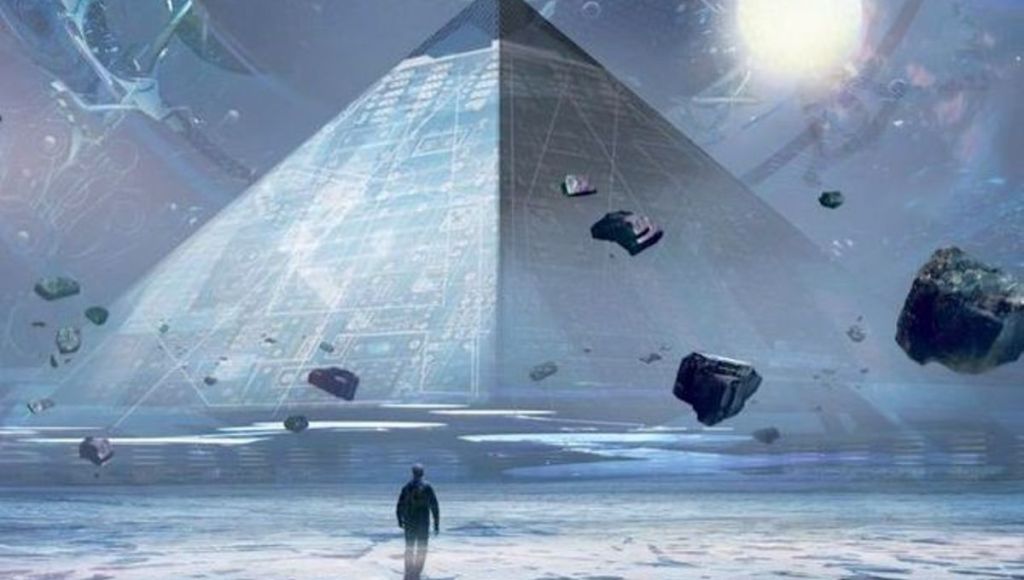
The first entry to the series is the the most distinct of the three and in my opinion the worst one. There isn’t anything truly bad about it, aside from the main character being a bit boring and I’ve loved it when I read it, but once you read the second two, Three body problems starts looking like a kids book. Where the third book left me in aw, the second one totally blew my mind, this one just had me going „that was really nice“. Our protagonist is Wang Miao – a nanomaterial researcher who starts experiencing weird stuff. He is……. fine. Everything that happens to him during the book is really cool, especially the behind the eyes countdown and his experiences in the three body problem game, but his backstory isn’t the best fleshed out and his personality is a bit bland. But as I said, we don’t spend that much time with him, because the other main storyline takes places a few decades earlier during the Chinese cultural revolution (an event I knew very little about before reading this book) and follows a young astrophysicist Ye Wenjie and her character and backstory are anything but bland. We see her go through the immense trauma of losing her father to a regime she disagrees with and her subsequent abuse by that regime, which keeps her around only because of her talent and knowledge. We get to watch her slowly growing disillusionment with the world and the human race at large, to the point that justifies her mankind-condemning act. That’s the morbidly fascinating part about these books. Every stupid choice the characters make, every terrifying revelation about the universe feel right. It’s feels natural. I’d also be remiss if I didn’t mantion Da Shi. He’s fits perfectly to the „tough cop who doesn’t play by the rules but he’s so good at his job we keep him around anyways“ trope, but I love that type of character and here it’s executed flawlessly. There isn’t as much hard science in this one, making it the perfect entry point, so I wasn’t really able to find if it works. The three body problem is a real thing that truly doesn’t have a all scenarios satisfying solution and the 11 dimension – proton computer is probably impossible, but there’s no way for us to know yet, so I’m giving it a pass.
DARK FOREST
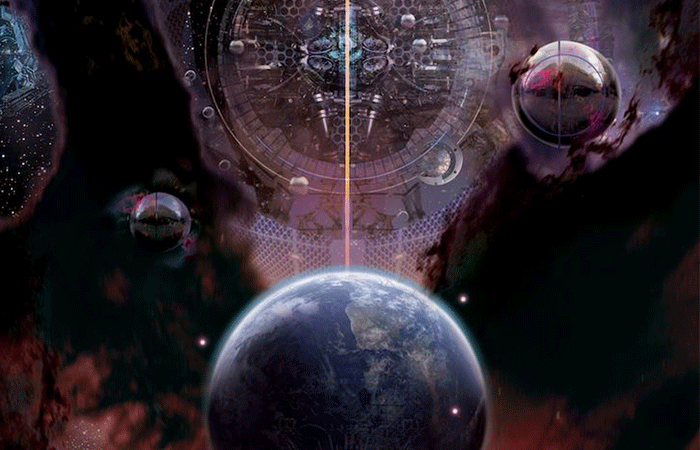
Now we’re getting into the good stuff. The second book – Dark forest is my favorite out of the trilogy. It has a very carefully crafted story full of strong themes and amazing foreshadowing. You are given the clues you need to figure out the big reveal of what the dark forest really is, but we kind of forget about them (like Danny about the iron fleet XD), even though we are subtly reminded of them and their importance multiple times. That’s why once the reveal finnaly hits, it hits that much harder, because you remember all the things that were pointing you to it. I remember sitting there with my jaw dropped to the floor when I read Luo Ji’s explanation of his cosmic sociology. It’s so dark and hopeless, yet it makes so much sense. The same can be said for most of the major plot twists. The battle in the darkness was the second biggest highlight for me. After most of the solar fleet is destroyed two groups of two ships escape to find a new home for humanity, but when they realize they don’t have enough supplies for both of the ships, their minds slowly twist becoming something very similar, but not quite human, losing any sort of moral code and only caring about survival, which leads to the enevitable conclusion, that they have to preemptively destroy the other ship, because if they don’t do so and begin negotiations, the other ship might just destroy them. Which is a small scale model of the dark forest theory revealed later. At this point the theme of nihilism in the series becomes very clear. Hinted at earlier with lines such as „you are insect“, now it’s full blown. Humanity is insignificant in the state we’re in now and once we advance we’ll inevitably alert a technologically superior civilization with the means to wipe us out, which they’ll do, because they can’t take the risk of us going through a technological boom and surpassing them and any chance for peaceful coexistence is crushed by the endless chain of suspicion leading to one of the civilizations „pressing the destroy button“ sooner or later. The only way to survive is to hide untill you’re more advanced than your opponents and than destroying them immediately. This is Liu Cixin’s solution to the Fermi paradox (it points out the contradiction between high propability of extraterrestrial life and its visible lack in the milky way). Once you’re able to detect other civilizations you become dangerous for them, causing your destruction. The ramifications of this on the human mind are throughoutly examined in the book. We see acts of genecide committed without any regrets, by people who lost all hope. Not everyone reacts in this way though. That’s where we get to our main protagonist and my favourite character from the series, Luo Ji. He’s not a very likable character at first. He’s an unsucesfull sociology major who gets put into a position of absolute power because Ye Wenjie told him the basic axioms of the dark forest theory, endangering his life, because the trisolarans know he’s the only person capable of figuring out a way to stop them. Because of this he’s chosen as one of the wallfacers, a select few who are supposed to secretly come up with a plan of defense and who are given unlimited authority and resources to do so, which Luo begins promptly abusing, as he uses them to live a luxurious life and doesn’t even try to come up with something. And again his position is understandable, defensible even. He was put into mortal danger by no choice of his own and he didn’t really have anything to live for before (we are shown his relationships failing, because of his unobtainably perfect image of a woman in his mind), so when he gets access to unlimited resources, he doesn’t help humanity. He helps himself and orders Da Shi (the lone returning character) to find him the girl of his dreams, which Da Shi surprisingly manages to do and they actually develop a relationship and have a child. When he’s later separated from his wife and daughter as a means to get him to work, he finally gains a motivation to do something and we see him grow and mature from a selfish burnt out brat to a selfless caring individual willing to sacrifice himself for the good of humanity. His story is amazingly captivating and a little heartbreaking, but he does get to meet his love once again, but only when he has proven he’s worth it, by his willingness to let everything go for the greater good. Surprisingly even thought we get a lot more technological stuff thrown at us, it still mostly holds up. The strong interaction material could possibly exist (though probably with different properties) and fusion engines could exist pretty soon, so yeah A+ on this level as well, nearly a flawless book in my opinion.
DEATH’S END
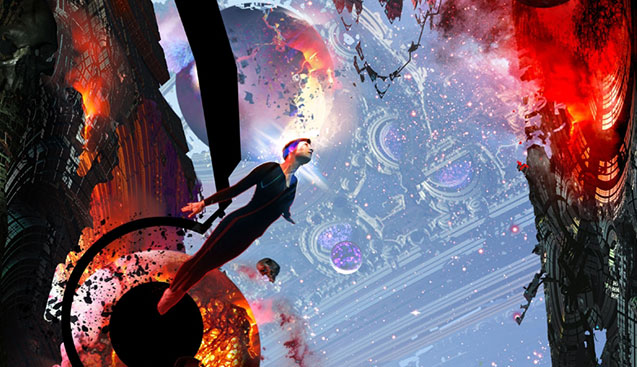
This one falls in the middle for me. It’s very similar to Dark forest both in scope and in length, but it doesn’t feel as tight as Dark forest did. The pacing is quite a bit slower and we loose the twists that kept me on the edge of my seat for the last third of book two, for more contemplatory content. We get another awesome protagonist in form of Cheng Xin. She’s a lot more likable than Luo Ji, she very compassionate (which ironically leads to the destruction of Earth), but she doesn’t forego the intense character development of Luo Ji. We also see her tragic romance with Yun Tianming. They end up as literal star-crossed lovers, becouse once they realize their feeling, they only see each other once and through a screen still being light years apart. The third entry to the series is the most ambitious and grand (like, Earth is destroyed for example), yet it somehow manages to be the most human at the same time. Cheng Xin feels great sadness for the hole of humanity (she ends up being the last surviving member of it) and we grief with her. My favourite part of this book would be Yung Tianming’s fairy tales. They pose as a riddle for both the characters and the reader, but these ones are theoretically solvable unlike the grand riddle of the dark forest. And there’s also just something enchanting about them. If you told me those were real fairy tales I would believe you, but they contain very cleverly hidden messages. This is unfortunately the point in the series where the science gets too fantastical and starts to crumble. I couldn’t find anything similar to a black domain and the concept of making light unable to escape only exist behind the event horizon of a black hole. But it ties nicely into the story so I’m willing to suspend my disbelief. The theme of nihilism is still present. Earth is destroyed and the universe will soon follow, the Dark forest is a universal constant in all dimensions and the only way to survive, is to lock ourselves inside of a literal sphere of darkness forever. But more than before, it is subverted here. Earth might be no more, but humanity didn’t die out and as the end of the universe approaches, Liu Cixin decides not to go with the wildly accepted scenario of heat death (the space expands forever, eventually becoming too cold for life to exist) and chooses instead to go with the unlikely scenario of a big crunch (the expansion of space eventually reverses, it collapses back to a infinitely small point and resets with another big bang) and though noone will survive to see the new universe, Cheng Xin and Guan Yifan, the last surviving people, leave a hard drive with all the knowledge of Earth and Trisolaris in a pocket dimension, as a remeberance of Earth’s past.
 talepunk.movie.blog